

Managing student records has never been simple.
But in today’s environment, student records management for schools has to be secure, compliant, and efficient, all at the same time.
From cumulative folders and IEP documentation to transcripts and enrollment forms, K–12 districts manage an enormous volume of sensitive data. And the challenge isn’t just storing it. It’s protecting it, retrieving it quickly, and controlling who has access.
For district administrators and IT teams, managing student records isn’t just paperwork—it’s protecting student information while keeping daily operations running smoothly.
The question many districts are asking now is:
How do we modernize student records management without creating more complexity for staff or IT?
The answer starts with structure.
The Hidden Complexity in Student Records Management
Many districts already have digital components in place. Some files are scanned. Some documents are saved to shared drives. Some forms are submitted electronically.
But often, the overall process still includes:
- Paper enrollment packets
- Manual document sorting
- Shared drive storage
- Email attachments with sensitive information
- Archived student files in physical storage
It feels manageable… until it isn’t.
A FERPA request comes in.
An audit requires immediate documentation.
Access permissions aren’t updated after staffing changes.
A cybersecurity incident exposes unsecured file shares.
Student records management becomes complicated when information lives in too many disconnected places.
Centralized K–12 Document Management Without Replacing Your SIS
Modern K–12 document management platforms like DocuWare are not replacements for your Student Information System (SIS). Instead, they act as a secure document layer that supports it.
Instead of fragmented storage, districts gain:
- A centralized digital student folder
- Role-based access controls
- Full audit trails
- Encrypted document storage
- Automated retention policies
This type of secure document management for schools reduces reliance on shared drives and paper files while staying aligned with existing IT infrastructure.
The result? Less confusion. More visibility. Stronger control.
Strengthening FERPA Compliance Without Extra Work
FERPA compliance isn’t optional, and managing it manually can create risk.
Shared folders rarely offer clean permission structures. Paper files provide no visibility into who accessed what.
With structured student records management:
- Access is assigned by role (counselors, administrators, special education, etc.)
- Sensitive files can have additional restrictions
- Every document interaction is logged
- Retention timelines are automated
FERPA compliance tools should simplify oversight, not create new administrative steps. When compliance is built into the system, staff don’t have to manage it manually.
Backfile Scanning for Schools: Protecting Decades of Student Records
One of the most overlooked challenges in K–12 document management is legacy paper records.
Many districts still maintain decades of cumulative student folders in storage rooms or offsite facilities.
Backfile scanning for schools allows districts to:
- Digitize archived student records
- Make historical files searchable
- Reduce physical storage costs
- Protect documents from physical damage
- Apply modern security controls to older files
Modernizing student records management isn’t just about new enrollments. It’s about protecting every record your district is responsible for, past and present.
Using Workflow Automation and RPA to Reduce Administrative Burden
Secure document management for schools doesn’t stop at storage. It can also streamline how student records move through the district.
Workflow automation can:
- Route enrollment documents to appropriate departments
- Trigger notifications for missing documentation
- Track transcript requests
- Digitally manage approval processes
In some cases, robotic process automation (RPA) can bridge gaps between systems, allowing information to move between platforms without requiring a full system replacement.
The goal isn’t flashy automation. It’s removing repetitive manual work so staff can focus on supporting students.
Supporting Internal IT — Not Adding Complexity
Most K–12 districts have internal IT teams managing devices, networks, and cybersecurity.
Secure student records management should support that work, not complicate it.
By centralizing documents, districts can:
- Reduce unsecured shared drives
- Standardize permission structures
- Improve visibility into document access
- Strengthen overall cybersecurity posture
Instead of adding another siloed system, document management creates order in an area that often evolved organically over time.
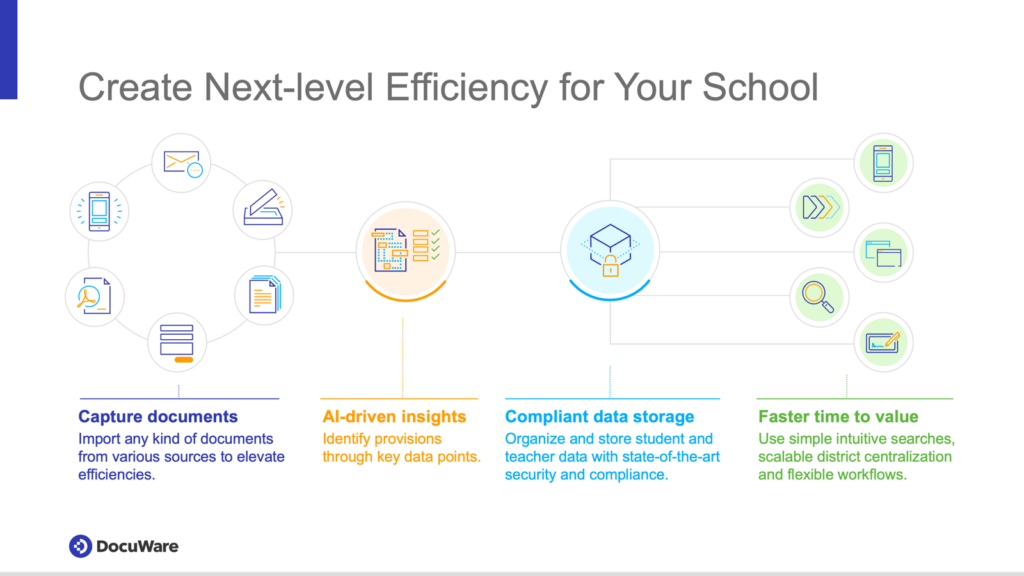
What Modern Student Records Management Looks Like for Schools
Managing student records without adding complexity means:
- A secure digital cumulative folder
- FERPA protections built into the system
- Archived records searchable in seconds
- Clear role-based access
- Automated retention policies
- Reduced dependency on paper
It’s not about replacing systems.
It’s not about overwhelming staff with new tools.
It’s about creating a secure, structured environment where student records are protected and easy to manage.
Because in K–12, protecting student information isn’t just an operational responsibility.
It’s a trust responsibility.